

The following was written by Dean Foreman, Ph.D., Chief Economist at the Texas Oil & Gas Association (TXOGA):
The Texas Oil & Gas Association’s (TXOGA) Quarterly Energy Economics Review has evolved into a flagship publication for the oil and natural gas industry, offering actionable insights by translating economic developments into practical implications for our members and stakeholders interested in energy market fundamentals.
As of this writing, the global economy is navigating a rare combination of economic dynamics. Abundant liquidity and low interest rates are fueling asset price appreciation, yet significant risks and uncertainties are simultaneously driving demand for defensive assets. Only a few periods in modern history—the economic downturn (marked by high inflation and unemployment, “stagflation”) in the 1970s, the Dot-Com Bubble (1990–2000), the post-Great Financial Crisis recovery (2010–2011), and the COVID-19 pandemic (2020–2021)—have seen similar dual valuations of both risky and defensive assets.
The global economy in 2024 is larger than ever, with official projections suggesting annual growth of 2.8% in both 2025 and 2026, consistent with historical averages. Rather than a “soft landing,” this scenario resembles a “no landing” trajectory, where growth continues unimpeded barring unexpected shocks. A broad range of economic indicators supports this optimistic view.
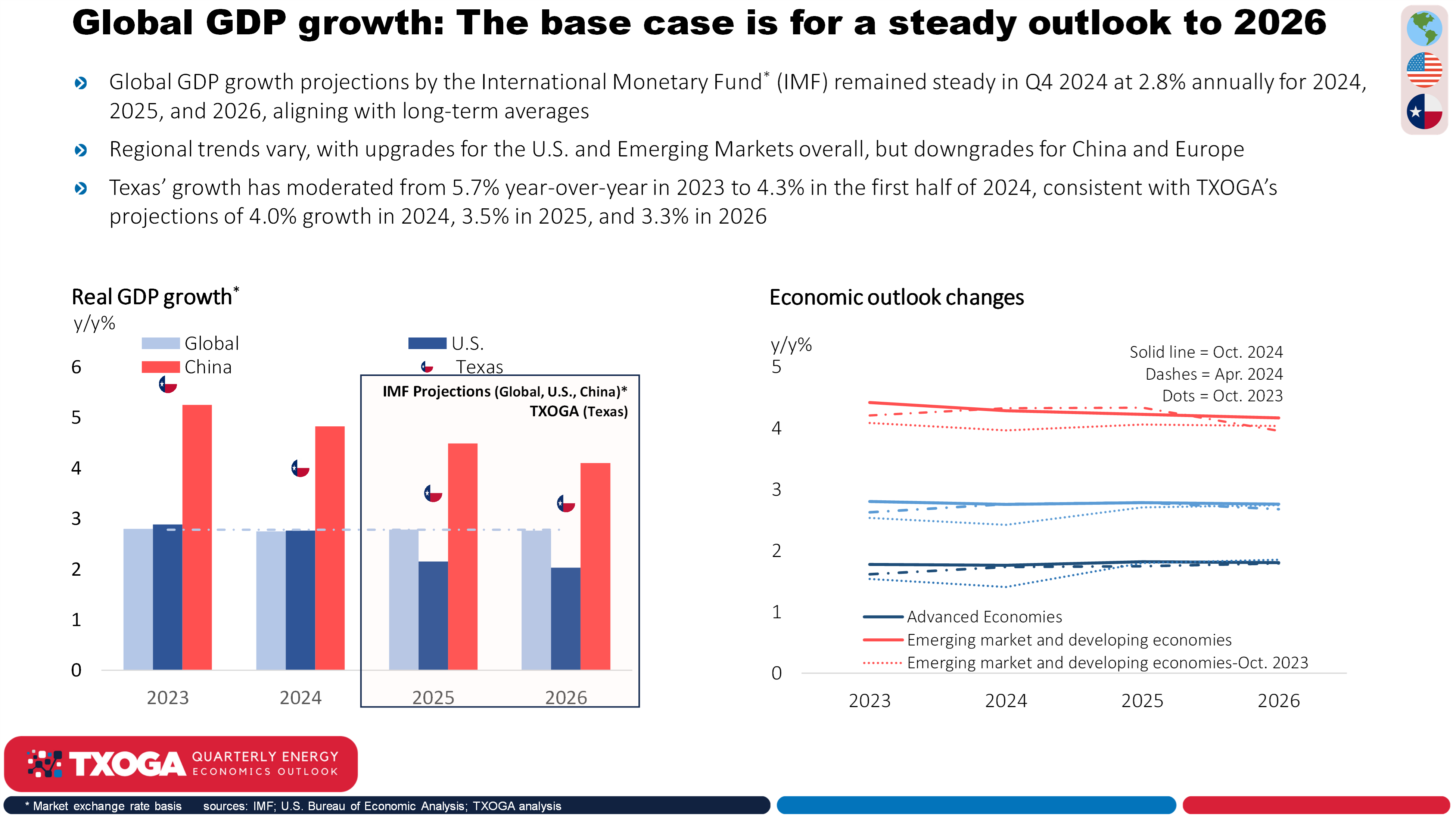
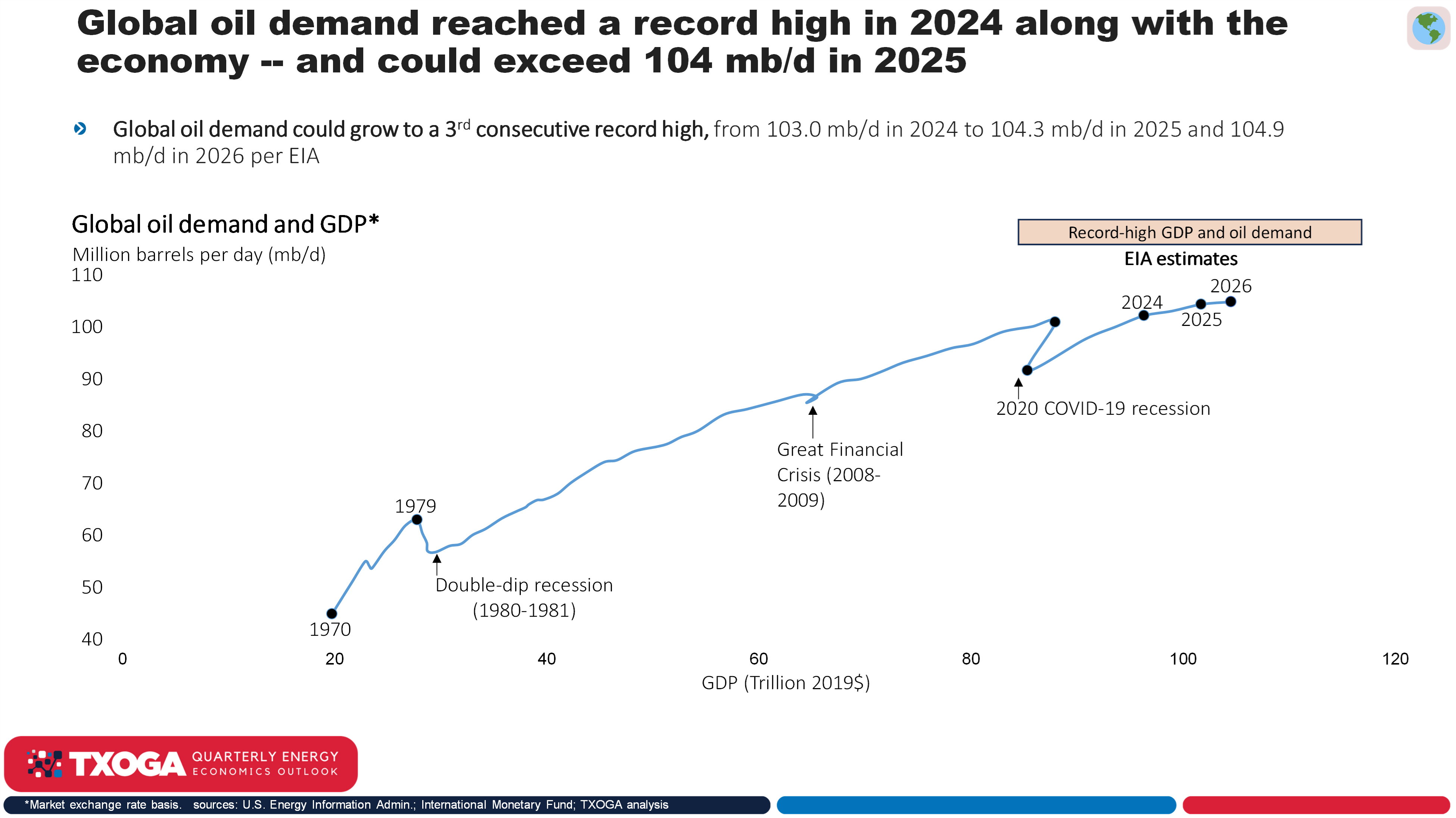
Unprecedented energy demand could accompany the record-and-growing global economy. By 2026, global oil demand is expected to reach 104.9 million barrels per day (mb/d), while natural gas consumption is projected at 154.3 trillion cubic feet (Tcf), per the Energy Information Administration (EIA). Emerging Markets and Developing Economies are driving this growth, with China continuing to lead despite concerns over its slowing economy. On the supply side, long-lead conventional oil projects in Brazil, Canada, Guyana, and Norway are poised to contribute meaningfully. However, the United States remains the largest single source of growth, accounting for 25% of global oil and natural gas supply additions in 2025.
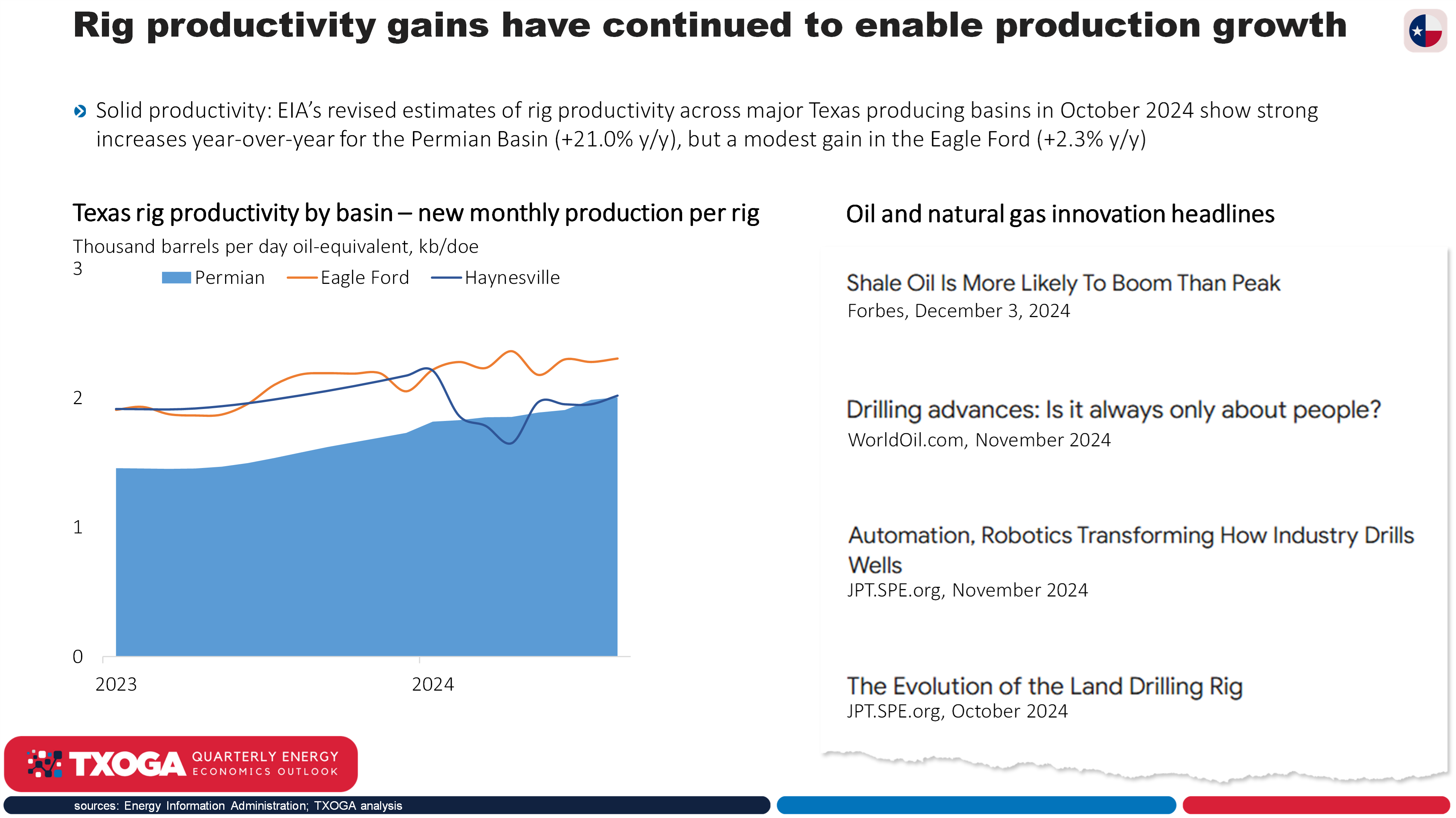
It’s worth noting that “U.S. oil and natural gas growth” is somewhat of a misnomer, as nearly all the nation’s production gains in 2024 came from Texas and New Mexico. The Permian Basin, which remains the most prolific region in both states, has been a remarkable story, with productivity reaching new heights. According to the EIA, new production per rig-month in the Permian Basin increased by 21.0% year-over-year as of October 2024.
The industry’s shift from emphasizing initial production rates to focusing on improved resource recovery has driven these gains. Horizontal drilling advancements, such as extended lateral well lengths, have enabled access to larger volumes of oil- and gas-bearing rock, reducing unit production costs. Meanwhile, enhanced well completions, advanced proppants, real-time data analytics, and automation have empowered operators to optimize production efficiency and minimize downtime.
To summarize, a growing global economy could propel oil and natural gas demand to consecutive record highs in 2025 and 2026. Supplies remain abundant and historically low-cost due to U.S. productivity gains and the culmination of conventional projects in non-OPEC nations. While this environment is favorable for consumers and economic growth, discrete risks and uncertainties loom on the horizon.
One such risk is intensifying competition among major economies. Efforts to advance domestic prosperity—or, in the United States’ case, defend its global position via tariffs—are increasingly resembling a zero-sum game. Geopolitical tensions and a rising U.S. dollar, which recently reached its highest value since 2006, add further complexity. The Federal Reserve Board reported a 4.3% appreciation in the dollar’s value between September 30 and November 30, 2024—one of the top 5% strongest moves on record since 2006. A strong dollar has historically exerted downward pressure on oil prices, a trend that has persisted in recent quarters.
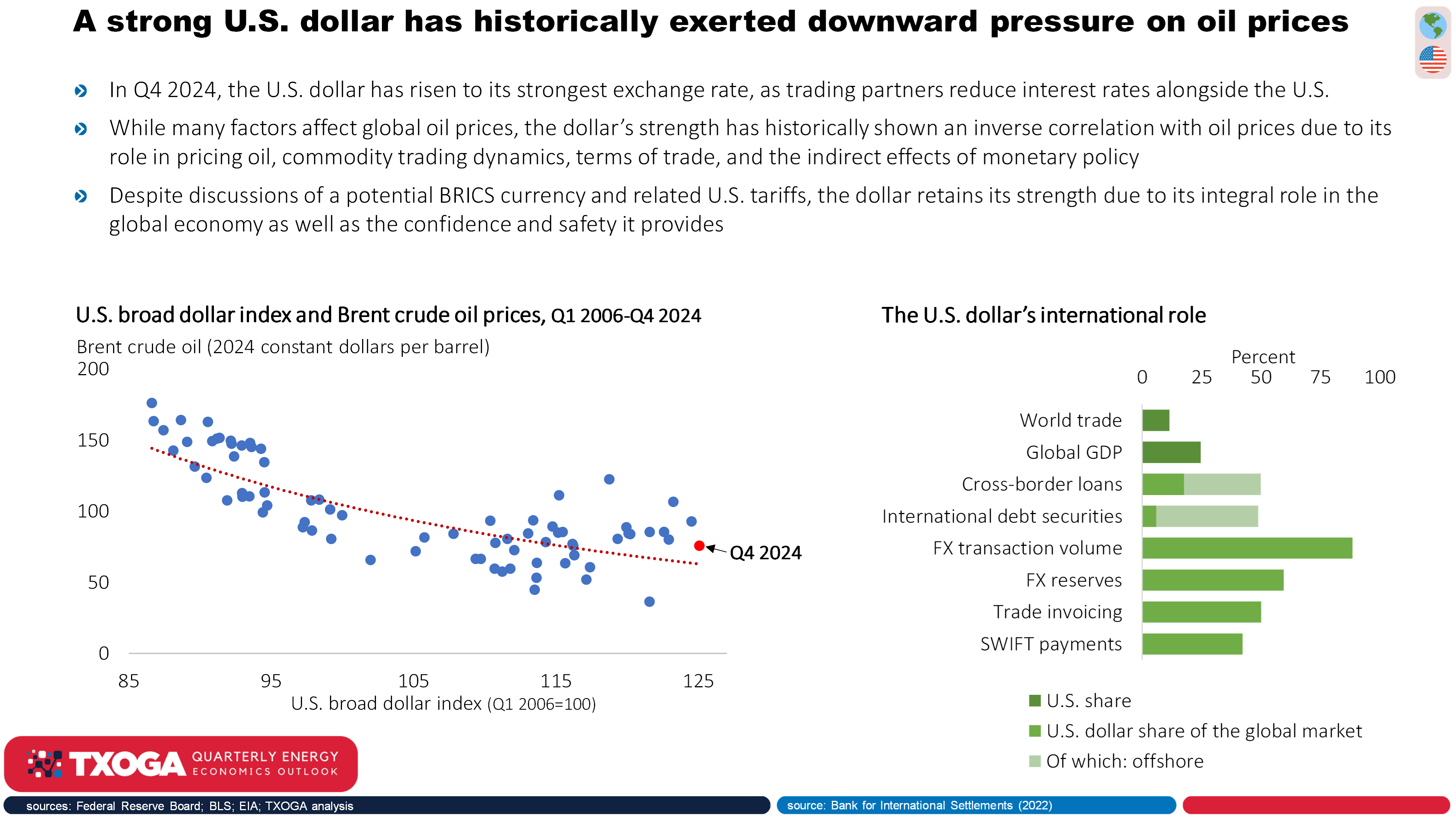
Additionally, a strong dollar over time widens the U.S. trade deficit by making exports less competitive and imports cheaper. In the first three quarters of 2024, the U.S. trade deficit exceeded $1 trillion, according to the Bureau of Economic Analysis. A weaker dollar would better support U.S. objectives to stimulate economic growth, improve trade balances, and enhance fiscal sustainability.
President Trump’s proposed 100% tariff on BRICS nations (that is, Brazil, Russia, India, China, and South Africa) is ostensibly aimed at defending the dollar’s role as the world’s reserve currency. While the notion of a BRICS currency has gained traction, the dollar’s dominance remains underpinned by its role in GDP, international debt, global trade, and payment systems. Any actions to protect the dollar’s status, however, risk undermining market confidence in its stability.
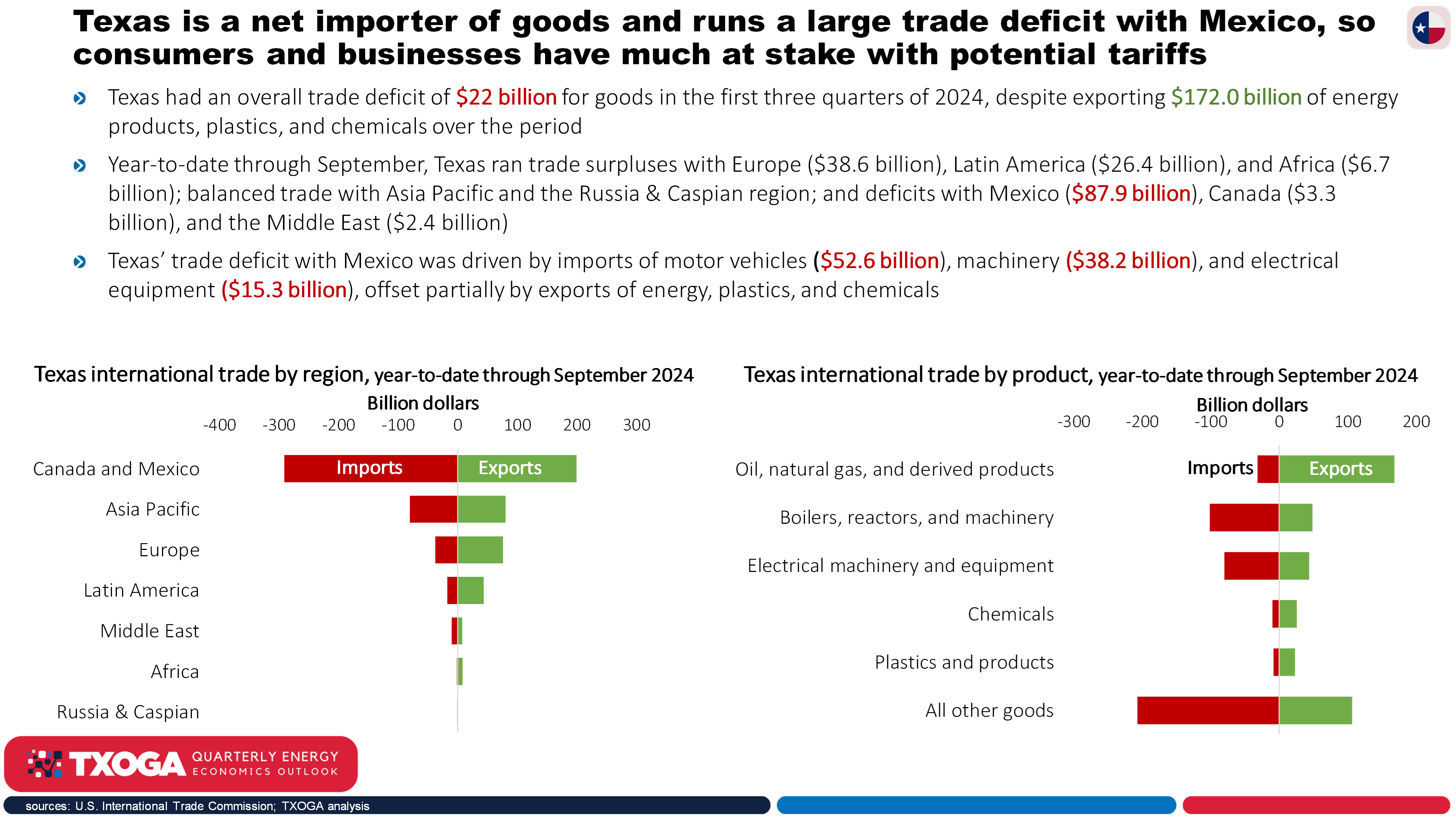
Tariffs also aim to rebalance trade and protect U.S. industries, but for Texas—where the economy is heavily energy-focused and intertwined with Mexico—such measures could have profound consequences. TXOGA’s Monthly Energy Economics Review (MEER) tracks Texas’ energy exports, which totaled $172 billion in the first three quarters of 2024, per U.S. International Trade Commission data. Texas also set a record for refined petroleum product exports at 4.5 mb/d, the highest globally. However, the state’s overall goods trade deficit, driven by manufactured imports from Mexico, highlights the risks of supply chain disruptions and retaliatory tariffs. Such challenges could erode the competitiveness of Texas’ energy, plastics, and chemical industries, undermining its economic strength.
In 51 years since the OPEC oil embargo of December 15, 1973, Texas and the U.S. have undergone a remarkable transformation. Once vulnerable to supply disruptions and price shocks, energy markets are now resilient—thanks in large part to Texas’ leadership in oil and natural gas production, which has continued to drive supply.
As we enter 2025, the combination of record-high global energy demand, amazing productivity gains, and emerging supply diversification presents new challenges and opportunities. Policies designed to protect domestic industries and rebalance trade must safeguard the long-term competitiveness of the energy, chemical, and manufacturing industries. Texas’ economy is intertwined with global markets and cross-border trade—and is therefore likely to be on the leading edge of any drastic policy shifts. Texas’ energy industry offers a blueprint to manage these challenges by supporting energy innovation and collaboration, underpinned by a commitment to safety, efficiency, and sustainability.
The message for 2025 is clear: Texas thrives when left to lead. Don’t mess with Texas.
Click here to read the Quarterly Outlook for Q4 2024.
+++
Founded in 1919, TXOGA is the oldest and largest oil and gas trade association in Texas representing every facet of the industry.