

The following was written by Dean Foreman, Ph.D., Chief Economist at the Texas Oil & Gas Association (TXOGA):
As we head into the second half of 2025, the global economy faces a widening gap between official growth projections and underlying risks. In addition to lowered expectations in Q1 2025, the International Monetary Fund (IMF) further downgraded its projections of global GDP growth by another 0.3% to 2.3% in 2025 and 2.4% in 2026 on a market exchange rate basis. Yet, those forecasts may still understate the compounded effects of trade frictions, consumer debt strain, financial market volatility, and escalated input costs across sectors. Geopolitical tensions—from disruptions in the Red Sea to Russia-related sanctions and trade volatility with China— add further uncertainties, with risks skewed to the downside.
Reading Between the Lines of Economic Indicators
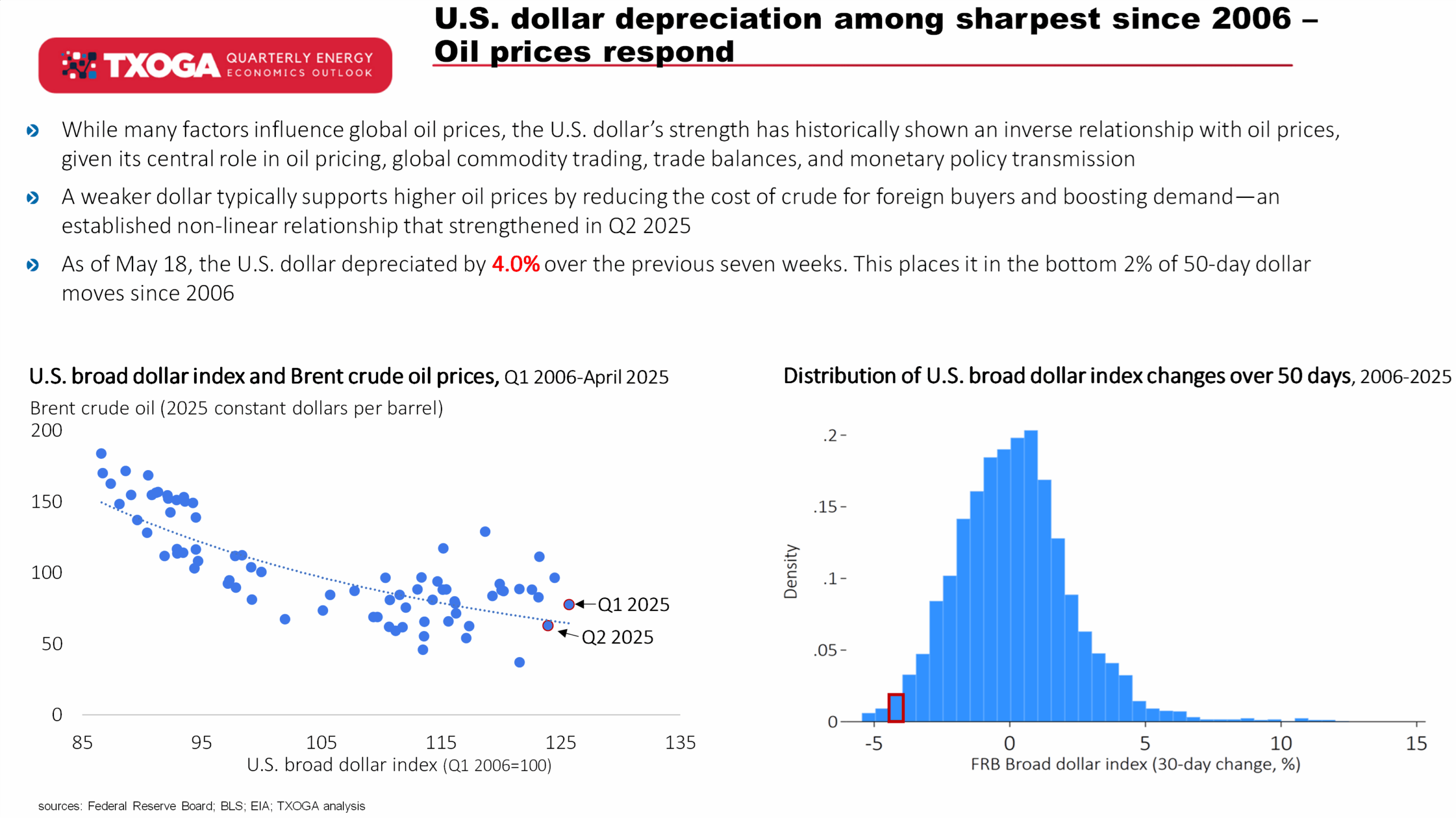
One of the more counterintuitive developments has been the depreciation of the U.S. dollar, which lost 4% of its purchasing power within seven weeks ending May 18 – despite elevated U.S. interest rates and tariffs that would traditionally support the currency. This ranks among the most bearish of such movements since 2006 and may reflect diminishing investor confidence in relative U.S. growth prospects or a broader risk aversion that tempers the typical “hot money” inflows into dollar-denominated assets.
Adding to these pressures, higher real yields and tighter credit conditions have significantly increased capital costs, particularly for long-horizon investments like energy infrastructure. For an industry already contending with increased input costs and softer prices across crude oil, natural gas, and refined products, this represents a double-bind – higher costs with muted revenues – evident in the cautious stance of 2025 capital guidance.
Some of this economic uncertainty may also be front-loaded into second-quarter activity, as companies advance projects to get ahead of policy changes. We’ll need to scrutinize upcoming GDP releases carefully to separate temporary accelerations from lasting trends.

Oil markets: Resilient demand, narrow margins for supply growth
Despite the economic headwinds, oil demand has continued to rise. The Energy Information Administration (EIA) projects global oil demand to reach a record 103.7 million barrels per day (mb/d) this year, up 1.0 mb/d from 2024. This strength is mirrored at home: U.S. crude oil production has averaged a record 13.5 mb/d year-to-date through May 9, 2025, with petroleum demand up 1.0% year-over-year and net petroleum exports averaging 2.9 mb/d – most of it led by Texas, based on EIA weekly data.


These aren’t signs of an economy in retreat. However, the broader supply picture suggests a limit to how much further U.S. and non-OPEC producers could grow in the near-term. While OPEC+ has announced aggressive production targets, EIA’s forecast – like current pricing – implicitly assumes they’ll undershoot their stated volumes. West Texas Intermediate (WTI) crude currently remains above $60 per barrel, within long-run mean-reversion bounds. But if OPEC+ production is increased or demand underperforms, something may have to give.
Importantly, refined product demand has remained solid, particularly for diesel and jet fuel. Gulf Coast refining margins have stabilized but remain sensitive to global capacity swings and export market competition.
Natural Gas: Record Output, Soft Near-Term Prices, and Long-Term Uncertainty
Natural gas’ story parallels that of oil. Global demand has remained on track for new records – 151.4 trillion cubic feet (tcf) in 2025 – despite the weakened macro backdrop. Emerging markets account for most of this growth, and North America, particularly Texas and the Gulf Coast, continues to dominate new LNG supply. U.S. net gas exports are forecast by EIA to rise from 12.6 billion cubic feet/day (bcf/d) in 2024 to 15.5 bcf/d this year and 17.6 bcf/d in 2026.
Even with China’s retaliatory trade policy, LNG demand has remained firm, particularly from Europe. This raises a key uncertainty, however, should U.S.-EU trade frictions escalate. Infrastructure additions like Plaquemines Phase 1, Corpus Christi Stage 3, and LNG Canada support supply growth—but these also rely on regulatory certainty and continued market access.
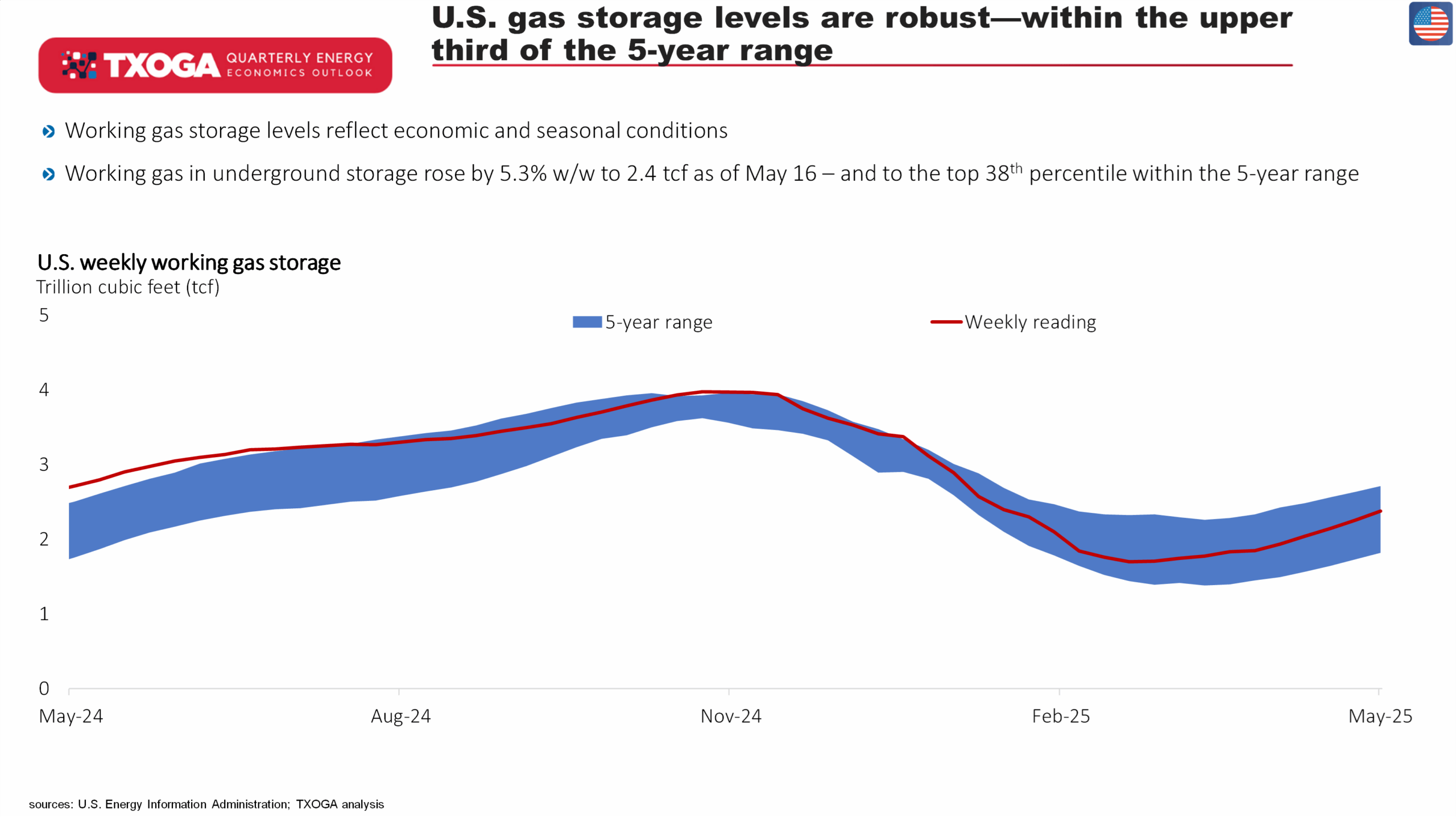
Domestically, U.S. gas storage has been replenished at a brisk pace – to the top 38th percentile of the five-year range as of May 16. That’s taken some wind out of near-term prices, which have returned to their historical mean-reversion threshold. Yet futures still point to higher prices through winter 2025–2026, apparently pricing in weather risks and the prospect of tighter balances if associated gas volumes ease and dry gas drilling fails to pick up. Continued investment in takeaway capacity from the Permian will be essential to fully realize this potential upside.

Efficiency and Selectivity: The Productivity Pivot
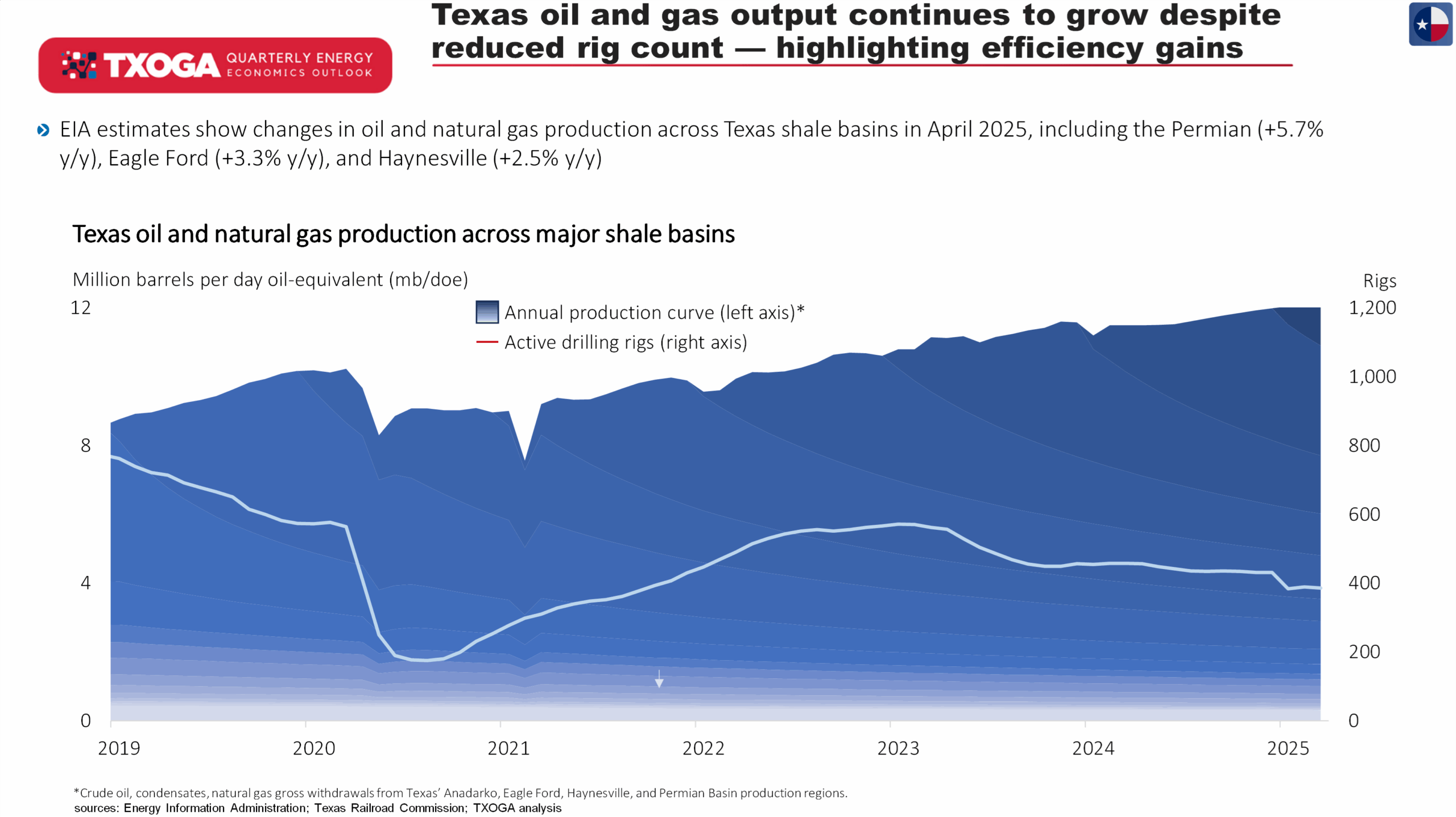
A final wildcard – and one of the most overlooked factors – may be the continued gains in rig productivity. Texas oil and gas production continues to grow despite a lower rig count, thanks to sharper capital discipline, increased use of drilled but uncompleted (DUC) wells, and efficiency improvements in drilling and completions.
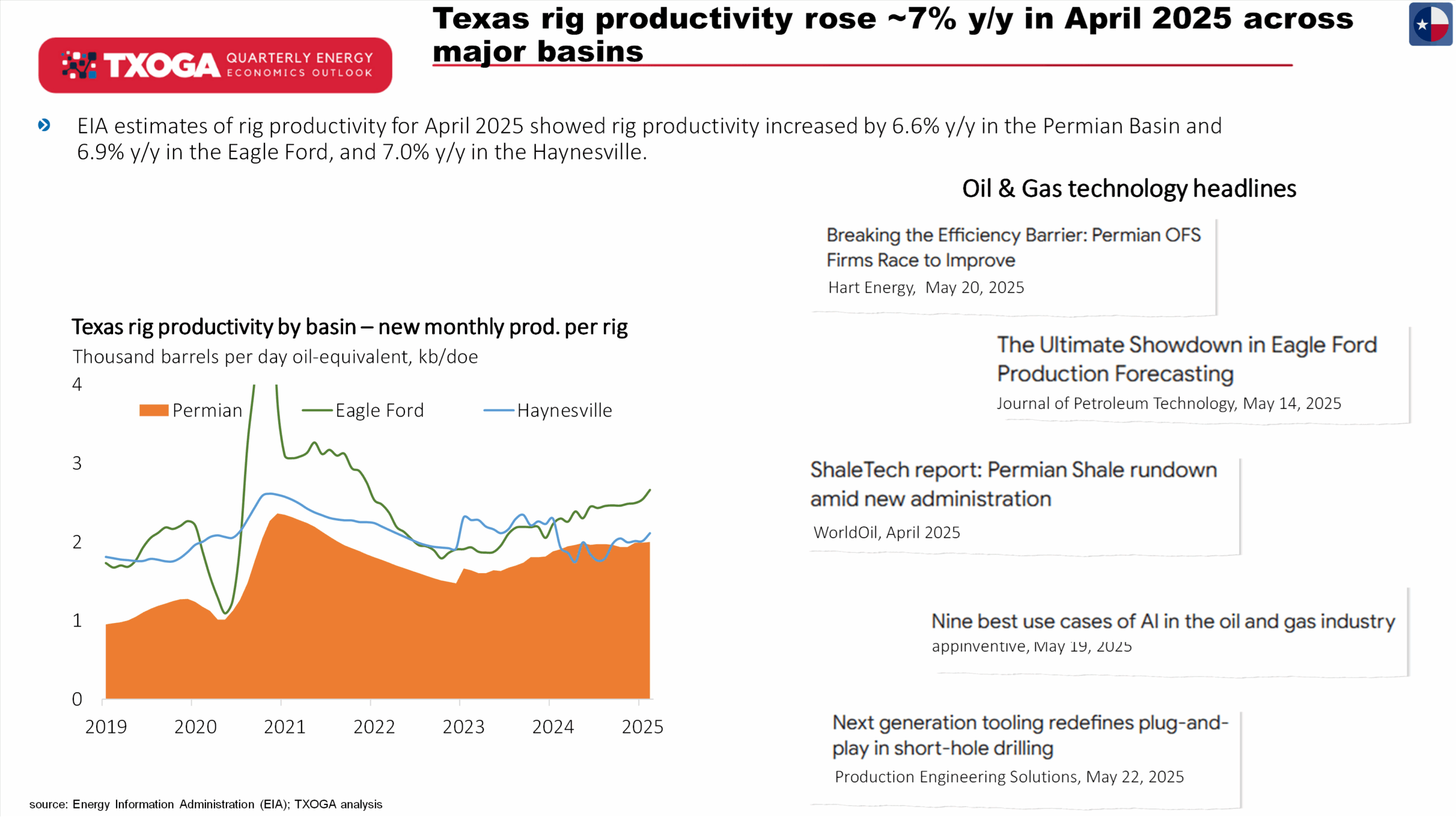
EIA data from April 2025 show year-over-year productivity gains of 6.6% in the Permian, 6.9% in the Eagle Ford, and 7.0% in the Haynesville. These gains are consistent with previous lean periods, when operators optimized output from fewer assets by focusing only on the most productive acreage and leveraging existing infrastructure.
Final Thoughts
Overall, the oil and natural gas industry is navigating narrow straits: operational and financial pressures have risen even as core demand fundamentals remained solid. Whether this tightrope walk leads to a rebound in investment or to deeper retrenchment depends on how policy, pricing, and productivity interact in the coming months. Texas remains a bright spot, and sustaining its long-term leadership will depend on staying ahead of infrastructure and regulatory challenges in a rapidly evolving global energy landscape.
Click here to read the full Q2 2025 Quarterly Energy Economics Outlook.
+++
Founded in 1919, TXOGA is the oldest and largest oil and gas trade association in Texas representing every facet of the industry.